Designing for an agent that doesn't exist yet
A B2B SaaS transitioning from document management to agentic automation.
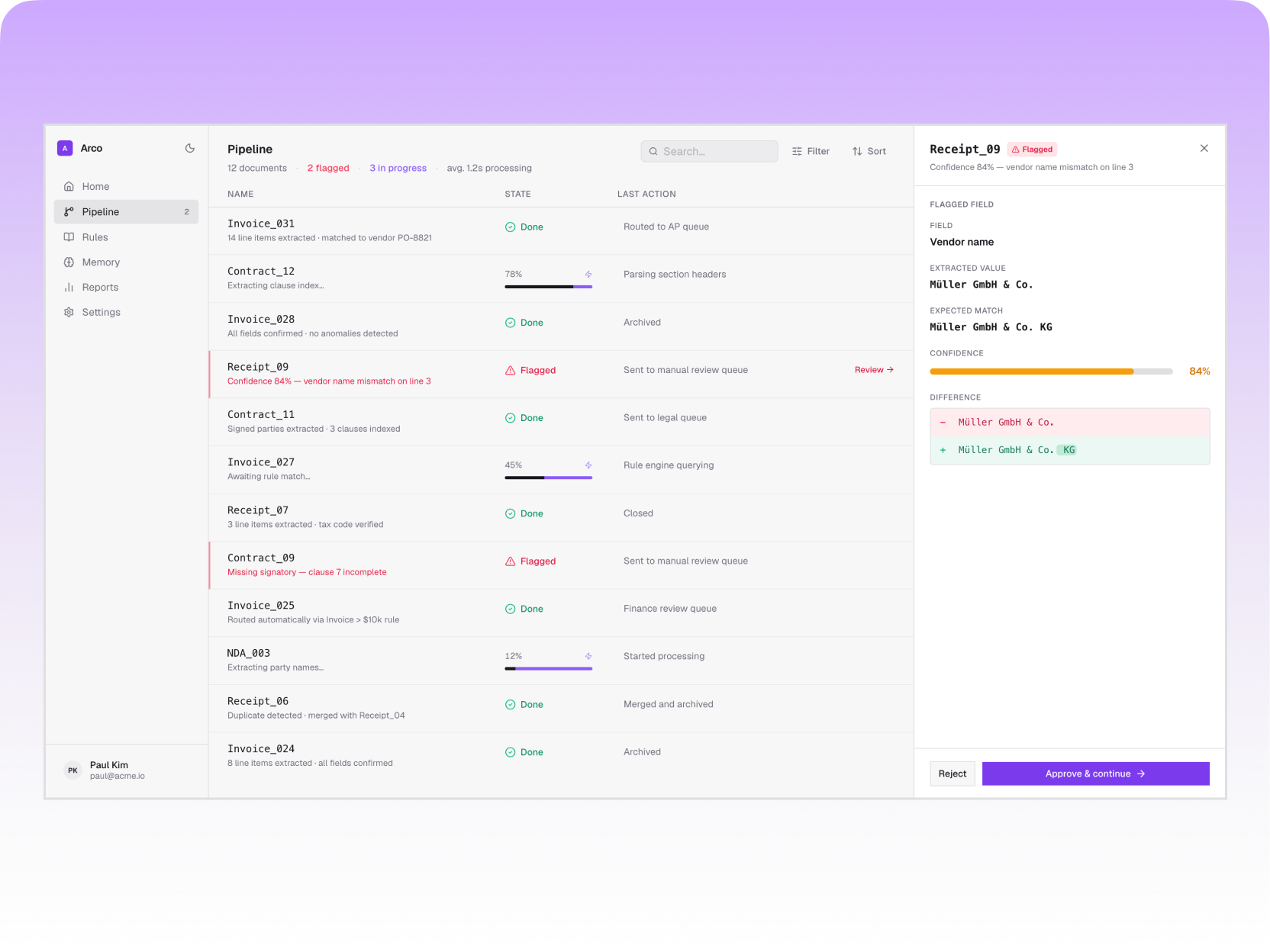
Company and product anonymised to protect confidentiality. Design decisions and visual assets reflect work done in role.
The product had a pipeline. It needed a mental model.
Arco was transitioning from a document management tool to an agentic SaaS, a product where AI handles the full document lifecycle from inflow to distribution. The technical architecture was clear. The user-facing logic wasn't clear. As the sole designer, the task was to define what this product should feel like to use, not just what it should do. This happened in close collaboration with product leadership: weekly sessions of whiteboarding, discussing direction, and stress-testing assumptions together.
Starting with objects, not screens
Before touching any UI, an OOUX analysis mapped the product's core objects and their relationships. The central finding: the document is the primary object. Extractions, automations, and outflow are things that happen to a document, not parallel concepts of equal weight. This had a direct consequence for navigation. The direction coming out of leadership organised the product around pipeline stages as the primary frame. The analysis showed that pipeline stages are system states, not user-facing objects. A user thinks in documents. The product should too. This reframing became the foundation for every design decision that followed.
A working prototype, not a slide deck
The design vision was validated by building it. A React proof of concept developed with Claude Code and VS Code, covering the full scope of the product's feature areas. Building with Claude Code made it possible to validate the object model in a working product, not just a clickable prototype. The architectural argument became testable, a necessary step before bringing the vision back to leadership and into power user testing.
The agent works. The user decides.
The home screen is where architectural decisions become visible. Organising a product around pipeline stages puts the system's logic in front of the user. Organising it around the agent's work and the documents that need attention puts the user's job first. Three questions drove the design: what did the agent handle while you were away, what needs a decision right now, and what does the document landscape look like. Every element on the screen answers one of these. Nothing else appears.
A foundation, not a concept
The OOUX analysis, prototype, and redesigned architecture gave the product team a concrete foundation to move from. Not a concept, a tested, working design direction ready for power user validation and management sign-off. The work reduced architectural ambiguity across the product's core feature areas, gave product leadership a shared reference point for prioritisation, and established a navigation model that scales as the agent layer grows.
Validating the direction
To pressure-test the architecture before leadership sign-off, I designed and ran an internal survey across commercial stakeholders. The finding: confidence in the agentic extraction model as a revenue-generating direction was high, and the document-first navigation mapped closely to how the sales team already described the product to customers. The design vision moved forward to power user testing with internal alignment already established, not as a proposal to debate, but as a shared reference point to build from.